Best AI Tools for Developers
The AI that writes, reviews, and ships alongside you.
The best AI tools for developers — code generation, review, debugging, agents, and automation that plug into how you already build.
- 76
 0
0Potentially is a private AI chat app built for people who want the power of multiple AI models without juggling multiple accounts, subscriptions, or apps. Instead of paying separately for tools like ChatGPT, Claude, Gemini, DeepSeek, Llama, and other AI models, Potentially gives users access to 100+ models in one simple experience. The app is designed for everyday AI use, whether you are writing content, brainstorming ideas, summarizing documents, researching topics, studying, comparing answers, creating social posts, drafting emails, or getting help with work and personal tasks. Users can ask questions, generate ideas, rewrite text, analyze information, and choose the AI model that works best for the task. One of Potentially’s biggest differences is privacy. Many AI tools require signups, track usage heavily, or store conversations. Potentially is designed around anonymous and private AI access, making it a strong option for people who want to use AI without attaching every prompt to their personal identity. This makes it useful for users who care about confidentiality, sensitive work, private research, personal questions, or simply having more control over how they use AI. Potentially also solves a common problem: not every AI model is good at the same thing. Some models are better for writing. Some are better for coding. Some are faster. Some are more creative. Some are better for research or reasoning. Instead of forcing users into one model, Potentially lets them explore and compare different models so they can get better results depending on what they need. The goal is to make AI easier, more flexible, and more affordable. Rather than subscribing to several AI platforms, users can use one app, one subscription, and credits when needed. This gives people more choice without the confusion of managing multiple tools. Potentially is ideal for students, creators, entrepreneurs, professionals, researchers, developers, marketers, and anyone who wants a smarter way to use AI. Whether someone needs quick answers, deep research, writing help, brainstorming, private conversations, or access to different models, Potentially brings everything together in one place. In simple terms, Potentially is a private, anonymous, multi-model AI assistant that lets users access 100+ AI models, compare results, and use the right AI for any task, all from one app.
- 77
 0
0Lovalingo eliminates i18n maintenance for the AI era. Traditional translation means manual JSON strings, broken layouts, and SEO headaches. With tools like Lovable, LLMs often "get lazy" and skip bulk translations, leaving your global growth stalled. Lovalingo fixes this by replacing legacy i18n with automated, render-native translation. Key Benefits: Native SEO: Automatically generates multilingual sitemaps, hreflang tags, and meta descriptions. Get indexed globally on day one. Zero-Flash UI: Unlike Weglot, we don't "hack" the DOM post-load. Translation happens during the React render - no flickering, no layout shifts. Vibe-Coding Ready: 100% compatible with Lovable, Bolt, and v0. Add one script, and your app scales to any language instantly. Zero Maintenance: No JSON files to manage. Auto-detects routes and updates content in real-time. Use Cases: SaaS founders scaling to international markets, agencies building on Lovable, and devs who hate manual i18n.
- 78
 0
0PrivateClawd is a platform for deploying and managing private OpenClaw AI agents in the cloud. Instead of running AI agents locally or managing complex infrastructure, PrivateClawd lets users launch autonomous agents in under a minute. Each agent runs on its own dedicated virtual machine and operates independently with full browser access, code execution capabilities, and messaging integrations. The platform is designed for founders, developers, marketers, and operators who want AI agents that can perform real tasks continuously without manual supervision. Users can deploy agents through a simple step-by-step wizard. The system handles all infrastructure automatically, including containers, networking, storage, and runtime management. Each agent can be configured with multiple capabilities such as: • Web browsing and automation • Code execution and scripting • Proxy configuration • File workspace and storage • AI model selection PrivateClawd supports multiple leading AI models through OpenRouter, including Claude, GPT, Gemini, DeepSeek, Groq and others. Users can either use platform tokens or bring their own API keys from supported providers. Agents can also connect to communication channels such as Telegram and WhatsApp, allowing users to interact with their AI agents through messaging apps. This makes it possible to run AI assistants, research agents, automation bots, and operational AI workers directly inside chat environments. The platform also includes a skills system with built-in capabilities for tasks such as content creation, SEO, analytics, marketing automation, strategy, and growth experimentation. Users can enable skills during agent creation or add custom ones later. Every agent runs 24/7 on dedicated infrastructure and remains isolated from other users, ensuring privacy and security. Files, configurations, and logs are preserved even when agents are stopped or redeployed. PrivateClawd is built to make autonomous AI agents accessible without requiring DevOps knowledge or infrastructure management. Users can focus on defining tasks and workflows while the platform handles deployment and runtime operations.
- 79
 0
0Most no-code builders treat APIs as an afterthought. Nobley doesn't. Import an OpenAPI spec or GraphQL schema and your client's backend becomes a fully typed, queryable data source in under 60 seconds — no manual wiring, no custom connectors. Then bind that live data directly to components, visually. On top of that, you get real app primitives: state management, event handlers, conditional rendering, and formulas. So you're building actual interactive web apps, not glorified landing pages. An AI agent helps you scaffold and build pages faster, so you spend less time on boilerplate and more time on the work that matters. And the pricing is built for how agencies actually work: €24/mo covers 5 client sites compared to Webflow's $14–23 per single site. Nobley is the only visual builder that combines serious API integration, real interactivity, AI assistance, and agency-friendly pricing in one product.
- 80
 0
0Hi-AI is an affordable, all-in-one, multimodal AI platform for content creators: videos, music, images, 3D, voice chat and reports. We use open-source, self-hosted AI models. Our models are inference-optimized in order to provide fast and cheap media generation. $5/month - AI Videos, music, voice, images, 3D, web search, news and reports.
- 81
 0
0Alma is an advanced AI platform designed around the concept of persistent memory, autonomous background agents, and unified creative tools. Unlike traditional AI assistants that forget previous conversations after each session, Alma is built to continuously remember user preferences, projects, communication styles, decisions, and ongoing work across every interaction. The platform positions itself as a long-term AI companion capable of evolving alongside the user, gradually building a deeper understanding of their goals, personality, workflows, and habits over time. By combining memory systems, research automation, creative studios, and productivity tools into one subscription, Alma aims to provide a more integrated and personalized AI experience. One of Alma’s core features is its persistent memory system. The platform automatically extracts useful information from conversations, such as personal preferences, writing styles, project details, recurring goals, and important decisions. These memories remain accessible across future chats, allowing the AI to maintain continuity and contextual understanding without forcing users to repeat the same information repeatedly. Users also remain in control of their stored memories, with options to review, edit, export, or delete saved data whenever needed. Alma describes this as a “complete memory system” that goes beyond simple vector storage by understanding personality traits, behavior patterns, communication preferences, and contextual relationships between topics. Another major feature of Alma is its system of autonomous background agents. Users can describe long-term goals or monitoring tasks in plain language, and Alma plans and executes them automatically over hours, days, or even weeks. Examples include competitor research, brand monitoring, scheduled reporting, trend analysis, or ongoing information gathering tasks. These agents operate independently in the background and periodically report findings back to the user. This functionality transforms Alma from a reactive chatbot into a more proactive digital assistant capable of managing long-term workflows and continuous research activities with minimal supervision. Alma also integrates multiple creative AI studios into a single workspace and pricing system. Users gain access to image generation, video creation, and music production tools under one shared monthly AI budget instead of paying for separate subscriptions across multiple platforms. The Image Studio supports advanced image models for generating, editing, upscaling, and refining visual content. The Video Studio includes support for cinematic AI video generation, storyboard planning, and avatar creation. Meanwhile, the Music Studio allows users to generate studio-style music tracks, focus loops, intros, and songs with optional vocals and lyrics. This unified creative environment is designed for creators, marketers, writers, designers, and content producers who need multimedia generation tools without managing multiple disconnected services. The platform also includes productivity and research-oriented capabilities aimed at writers, researchers, developers, and power users. Alma supports web search with AI-generated summaries, trend tracking, document generation, long-form writing assistance, grammar correction, translation, and export functionality for formats such as PDF, DOCX, XLSX, PPTX, HTML, Markdown, and JSON. Developers can access advanced integrations through APIs, bring-your-own-provider-key support, VS Code extensions, and MCP compatibility for connecting Alma with external development environments and AI-aware clients. These tools allow the platform to function not only as a conversational assistant but also as a workflow automation and knowledge management system. Another defining aspect of Alma is its emphasis on personalization and cognitive adaptation through what it calls the “Soul Engine v2.” This system allows the AI to develop a deeper understanding of user identity, worldview, communication style, reasoning preferences, and behavioral patterns. The goal is to create interactions that feel increasingly natural, context-aware, and tailored to individual users over time. Combined with automatic context assembly, Alma attempts to reduce the need for repetitive prompt engineering by dynamically selecting relevant memories and contextual information for each conversation. Overall, Alma presents itself as an all-in-one AI ecosystem that combines persistent memory, autonomous research agents, creative media generation, productivity tools, and personalized interaction systems into a unified platform. By focusing on long-term contextual understanding, automation, and integrated multimedia workflows, Alma aims to move beyond traditional chatbot experiences and become a continuously evolving AI workspace that adapts to the user’s personal and professional life.
- 82
 0
0Atomic Chat is a powerful, open-source AI platform designed to run entirely on your local device, offering a private, fast, and cost-free alternative to traditional cloud-based AI tools. Unlike most AI services that rely on remote servers, subscriptions, and data collection, Atomic Chat focuses on giving users full control over their data and experience. Everything—from conversations to processing—happens directly on your computer, ensuring complete privacy and independence from external systems. One of the defining features of Atomic Chat is its fully local operation. The platform does not send any data to the cloud, meaning that zero bytes of user information ever leave the device. This makes it particularly appealing for users who prioritize security, confidentiality, or offline access. In fact, Atomic Chat works 100% offline, allowing users to interact with AI models without any internet connection. This is a major advantage compared to cloud-based AI tools, which require constant connectivity and often impose usage limits or restrictions. Another key strength of Atomic Chat is its support for over 1,000 AI models. Users can choose from a wide variety of models, including well-known ones like Llama, Qwen, DeepSeek, Gemma, and others. These models can be downloaded and run locally with just a few clicks, giving users the flexibility to select the best model for their needs—whether it’s for writing, coding, research, or general conversation. The platform supports multiple formats such as GGUF, MLX, and ONNX, making it compatible with a broad ecosystem of AI models. Performance is also a major focus of Atomic Chat. It integrates a technology called TurboQuant, which significantly improves efficiency. TurboQuant allows models to run up to eight times faster than traditional setups while using much less memory. This means users can run larger and more advanced models on their own devices without sacrificing speed or quality. Despite heavy optimization, the platform maintains high accuracy, ensuring that responses remain reliable and effective. The user experience is designed to be simple and accessible. Installing Atomic Chat is straightforward, similar to installing any standard desktop application. Once installed, users can quickly select a model and start chatting immediately, without complex configuration or technical setup. The interface is clean and organized, with features like chat and project separation, allowing users to manage different tasks without losing context. Persistent memory across sessions also helps maintain continuity in conversations. Atomic Chat is also built with advanced use cases in mind. It supports autonomous workflows, meaning users can create AI agents that can think, act, and execute tasks locally. This opens the door to more complex applications, such as automation, personal assistants, or custom AI-driven tools—all running securely on the user’s machine. Being open-source is another important aspect of the platform. Users can inspect the code, verify how it works, and even modify it if needed. This level of transparency builds trust and gives developers the freedom to adapt the tool to their specific requirements. Overall, Atomic Chat represents a shift toward user-owned AI. By eliminating subscriptions, removing data tracking, and enabling fully local execution, it empowers users to take control of their AI experience. It is an ideal solution for those who value privacy, flexibility, and performance without relying on external services.
- 83
 0
0Hexabot is an open-source AI chatbot and agent solution that allows users to create and manage multi-channel, multilingual AI-powered chatbots with ease. Designed for flexibility and customization, Hexabot offers powerful text-to-action capabilities, enabling developers and businesses to tailor their bots to meet specific needs. Built by the community for the community, Hexabot empowers individuals and organizations to create innovative, interactive agents and democratizes access to AI technology.
- 84
 0
0Fallom is an AI-native observability platform for LLM and agent workloads that lets you see every LLM call in production with end-to-end tracing, including prompts, outputs, tool calls, tokens, latency, and per-call cost. We provide session/user/customer-level context, timing waterfalls for multi-step agents, and enterprise-ready audit trails with logging, model versioning, and consent tracking to support compliance needs. With a single OpenTelemetry-native SDK, teams can instrument apps in minutes and monitor usage live, debug issues faster, and attribute spend across models, users, and teams.
- 85
 0
0OpenYC is an AI-native startup accelerator designed to help founders build technology that creates measurable public benefit rather than focusing exclusively on private profit. Built around the principles of openness, artificial intelligence, and digital public infrastructure, OpenYC offers a new model for entrepreneurship where startups are encouraged to solve real-world societal challenges while creating products that can be shared, reused, and expanded by others. Unlike traditional startup accelerators that primarily focus on venture capital growth and proprietary software, OpenYC is built on the belief that technology should contribute to the public good. The platform connects founders, developers, researchers, and innovators with AI-powered programs designed to help them launch impactful projects faster and more efficiently. Every program is guided by specialized AI agents that help participants move from idea to implementation while providing structured support throughout the development process. A core concept behind OpenYC is the integration of Digital Public Infrastructure (DPI). Rather than building isolated applications that operate independently, participants are encouraged to connect their solutions to existing public digital systems, such as city infrastructure, public services, healthcare platforms, educational networks, and government technologies. This approach enables startups to create tools that have a broader societal impact while benefiting from established ecosystems and data sources. Another defining feature of OpenYC is its Public Domain Agent (PDA) framework. Each domain or sector is paired with a dedicated public AI expert designed to provide guidance, knowledge, and support specific to that field. These AI agents act as specialized advisors, helping founders navigate complex challenges, identify opportunities, and accelerate decision-making. Because the agents are designed as public resources rather than proprietary tools, they contribute to OpenYC's mission of making expertise more accessible and scalable. The accelerator focuses heavily on Digital Public Goods (DPGs), meaning that the projects created within the ecosystem are intended to be public, reusable, and beneficial to wider communities. Instead of locking innovation behind proprietary barriers, OpenYC encourages founders to contribute solutions that can be adapted and expanded by governments, organizations, researchers, and communities around the world. This philosophy promotes collaboration, transparency, and long-term societal value. OpenYC supports a wide range of mission-driven initiatives across healthcare, government technology, education, public services, accessibility, and social impact sectors. Examples include projects such as Medicare.dev, which aims to simplify healthcare access, and Crohn's AI, which provides support and resources for people living with Crohn's disease and inflammatory bowel diseases. These examples demonstrate the platform's commitment to addressing meaningful problems that affect real people rather than pursuing technology for its own sake. The platform combines startup acceleration with AI-powered execution. Founders gain access to structured programs, specialized AI guidance, collaborative development workflows, and public infrastructure integrations that help reduce barriers to launching impactful products. By leveraging AI agents throughout the process, OpenYC enables entrepreneurs to move faster while maintaining a focus on quality, accessibility, and measurable outcomes. Ultimately, OpenYC represents a new vision for entrepreneurship in the age of artificial intelligence. It seeks to align technological innovation with public benefit, empowering founders to create solutions that are not only commercially viable but also socially valuable. By combining AI-native workflows, digital public infrastructure, public domain expertise, and open innovation principles, OpenYC is building an ecosystem where startups can scale their impact while contributing to a more accessible, collaborative, and equitable digital future.
- 86
 0
0Locai is a private AI infrastructure platform that enables organizations to deploy, manage, and operate modern artificial intelligence models entirely on infrastructure they own and control. Instead of relying on cloud-based AI services for model inference, the platform is designed to execute language, vision, audio, and multimodal models on local hardware, private servers, virtual private clouds, edge devices, or fully air-gapped environments. By keeping computation within an organization's infrastructure, Locai emphasizes data sovereignty, security, regulatory compliance, and reduced operating costs. The platform is built around a unified ecosystem composed of three primary components: Workspace, Control, and Link. Workspace serves as the central user interface where employees interact with AI-powered tools, including document generation, database querying, audio transcription, and information retrieval. Control manages the deployment and orchestration of AI models across an organization's infrastructure, while Link enables applications and existing software systems to access locally hosted models through compatible APIs. Together, these components provide a complete environment for developing and deploying enterprise AI without requiring cloud inference. A major focus of the platform is supporting organizations that operate in environments with strict security or regulatory requirements. Locai is designed to function in completely offline or air-gapped deployments where no internet connectivity is available. This allows sensitive data, confidential documents, meeting recordings, videos, and operational information to remain entirely within the organization's own infrastructure. The platform positions this approach as an alternative to cloud-based AI services, enabling businesses to maintain full ownership and visibility over their data while reducing exposure to external infrastructure providers. Unlike many private AI solutions that concentrate solely on conversational language models, Locai supports multiple categories of AI models within a unified platform. These include large language models for chat, summarization, extraction, and AI agents; speech recognition models for meeting and call transcription; computer vision models for image analysis and object detection; and video processing models for local visual inspection and analytics. Because all of these models operate under the same management layer, outputs from one model can be consumed by another, allowing organizations to build integrated AI workflows without relying on multiple disconnected products. The platform also emphasizes interoperability and ease of deployment. Organizations can install the Control component on their own servers using a streamlined installation process, deploy models from an integrated registry or import their own models, and connect existing applications through an OpenAI-compatible API endpoint. Support is provided for popular model formats such as GGUF, ONNX, and TensorFlow Lite, enabling teams to deploy a broad range of open-source and custom AI models. Hardware flexibility is another key advantage, with compatibility across NVIDIA GPUs, AMD hardware, Apple Silicon systems, and CPU-only environments. One of Locai's distinguishing capabilities is its support for unified data workflows. Rather than treating language, audio, image, and video models as isolated systems, the platform allows information generated by one model to flow naturally into another. For example, an image recognition model can detect a manufacturing defect, pass the result to a document generation model, and automatically produce a quality assurance report without transferring any data outside the local environment. This integrated architecture simplifies enterprise automation while maintaining complete control over sensitive information. The website also highlights a version of the platform intended for software companies building AI-enabled products. Instead of paying for centralized cloud inference, developers can route model execution to their customers' own hardware, significantly reducing infrastructure costs while preserving privacy and scalability. This approach enables SaaS providers to deliver AI-powered features without assuming the full computational expense of serving every inference request from centralized cloud infrastructure.
- 87
 0
0WaveSpeedAI is the ultimate platform for blazing-fast AI-powered image and video generation. Whether you're a marketer, content creator, entrepreneur, or developer, WaveSpeedAI helps you build, create, and scale visual content with incredible speed and precision. With advanced generative models and an intuitive interface, WaveSpeedAI empowers you to: • Instantly generate high-quality visuals for social media, ads, websites, and more. • Produce AI videos from text, prompts, or templates – no technical skills required. • Customize your content with brand colors, AI voiceovers, avatars, and animations. • Save hours of production time and reduce creative bottlenecks with automated workflows. • Collaborate, edit, and export content effortlessly to suit any platform or campaign. From ideation to execution, WaveSpeedAI turns your creative vision into high-performing media at scale — faster than ever before.
- 88
 0
0WaveSpeedAI is the ultimate platform for blazing-fast AI-powered image and video generation. Whether you're a marketer, content creator, entrepreneur, or developer, WaveSpeedAI helps you build, create, and scale visual content with incredible speed and precision. With advanced generative models and an intuitive interface, WaveSpeedAI empowers you to: • Instantly generate high-quality visuals for social media, ads, websites, and more. • Produce AI videos from text, prompts, or templates – no technical skills required. • Customize your content with brand colors, AI voiceovers, avatars, and animations. • Save hours of production time and reduce creative bottlenecks with automated workflows. • Collaborate, edit, and export content effortlessly to suit any platform or campaign. From ideation to execution, WaveSpeedAI turns your creative vision into high-performing media at scale — faster than ever before.
- 89
 0
0Baselight is the antidote to AI hallucinations: a unified data layer that serves as the structured backbone for intelligent systems, connecting both humans and LLMs to verifiable, auditable facts. It provides a suite of tools—including an AI for explainable intelligence, an extensive catalog of dependable structured data, and a studio for transparent analysis—to ensure that every query is answered with truth, not guesswork, powering smarter, more reliable insights for everyone.
- 90
 0
0TextureFast - Fast Texturing For 3D Models In Seconds
real-time workflow tool·texture generation toolTextureFast is an AI-powered 3D texturing platform that turns raw 3D models into production-ready PBR assets in seconds. Built for modern game development, archviz, and real-time workflows, it replaces slow, manual texturing with fast, prompt-driven generation. Instead of spending hours in complex tools, creators can describe materials, apply style presets, and instantly generate high-quality textures optimized for real-time engines and scalable asset pipelines. Designed for speed, consistency, and flexibility, TextureFast helps studios and solo creators accelerate production while maintaining AAA-quality results across projects. Key features: Instant AI Texturing Generate high-quality PBR textures for 3D models in seconds using simple prompts and presets. Up to 4K Resolution Create crisp, production-ready textures suitable for AAA games, cinematic assets, and architectural visualization. Multi-Style Output Switch between photorealistic, stylized, handpainted, and other art styles to match any art direction. Game Engine Ready Supports GLB, GLTF, OBJ, and FBX formats with seamless integration into Unity, Unreal Engine, Godot, and Blender pipelines. Privacy-First Workflow All generations are private and NDA-safe, with no training on user assets. TextureFast is built for game developers and studios who want faster iteration, scalable pipelines, and high-quality results without the overhead of traditional texturing tools.
- 91
 0
0Plumbed.io introduces a new way of thinking about enterprise integrations by shifting the focus from simply building connections to fully owning and managing their entire lifecycle. Instead of treating integrations as one-time technical projects, the platform approaches them as living systems that must continuously adapt, evolve, and remain reliable in dynamic business environments. This shift is especially important in modern organizations where systems, tools, and data flows are constantly changing, and traditional integration approaches often struggle to keep up. At its core, Plumbed.io is a prompt-driven, AI-powered integration platform designed to dramatically reduce the time and complexity involved in connecting systems. What once took months of development, testing, and deployment can now be accomplished in days. The platform enables businesses to describe their integration needs in a straightforward way, allowing intelligent systems to handle the heavy lifting. This not only accelerates implementation but also reduces reliance on large engineering teams for ongoing support. One of the most significant advantages of Plumbed.io is its self-healing capability. Unlike conventional integrations that require manual monitoring and frequent intervention, Plumbed.io continuously observes system performance and automatically resolves issues as they arise. This proactive approach ensures that integrations remain operational without constant human oversight. As a result, businesses can maintain uninterrupted data flow and avoid costly downtime that often impacts productivity and customer experience. The platform also addresses a major challenge faced by many companies: the so-called “integration tax.” This refers to the hidden costs and delays associated with launching new channels, onboarding partners, or adopting new tools. Traditional integration projects often involve custom development, long timelines, and ongoing maintenance burdens. Plumbed.io eliminates these inefficiencies by replacing static integration projects with an AI-managed lifecycle that adapts over time. This makes it significantly easier and more cost-effective to scale operations and introduce new capabilities. Another key strength lies in its ability to automate the entire integration lifecycle. From initial setup to continuous monitoring, error handling, and system updates, every stage is handled intelligently by the platform. This level of automation allows organizations to focus on their core business activities instead of being bogged down by technical maintenance. It also ensures that integrations remain up-to-date as underlying systems evolve, reducing the risk of failures caused by outdated configurations. Plumbed.io is particularly valuable for enterprises that require complex, custom integrations that cannot be easily addressed by off-the-shelf solutions. The platform supports ongoing changes and adjustments after deployment, making it ideal for environments where requirements are constantly evolving. Rather than rebuilding integrations from scratch, businesses can rely on a flexible system that adapts in real time. The practical impact of this approach can be seen in real-world scenarios where companies face complex integration challenges. Plumbed.io works closely with innovative organizations to implement solutions that are not only functional but also sustainable over time. These use cases demonstrate how AI-native integration can reduce delivery timelines, minimize maintenance efforts, and improve overall system reliability. Each example reflects a real operating environment where success depends on more than just connecting systems—it requires ensuring those connections continue to perform under changing conditions. By combining speed, automation, and reliability, Plumbed.io enables faster launches without increasing operational overhead. Businesses can deploy new integrations quickly, reduce costs associated with custom development, and benefit from continuous optimization powered by AI. This makes it possible to grow and adapt without the typical constraints imposed by legacy integration solutions. Ultimately, Plumbed.io represents a fundamental evolution in how integrations are built and maintained. It transforms integrations from fragile, resource-intensive projects into resilient, self-managing systems. For organizations looking to scale efficiently while maintaining high performance and reliability, this approach offers a powerful and forward-thinking solution.
- 92
 0
0Nano Banana is an AI-powered creative platform designed to make image and video generation more accessible for everyday creators, designers, and developers. The tool focuses on producing high-quality visual content through simple text prompts, allowing users to generate new artwork, redesign existing assets, or refine visuals with intuitive controls. Instead of relying on complex creative software or time-consuming manual editing, Nano Banana streamlines the entire process into a fast, guided workflow that anyone can use, regardless of technical experience. The platform integrates multiple generation and editing models that support prompt-based creation, image transformation, and visual enhancement. This includes generating images from scratch, modifying uploaded photos, applying stylistic changes, and producing creative variations. For video-related tasks, Nano Banana enables prompt-driven video generation and visual redesign, giving users a new way to prototype ideas, create content, or enhance storytelling with minimal effort. Nano Banana is built with speed and clarity in mind. The interface is clean, simple, and optimized for rapid iteration. Users can experiment with different prompts, adjust parameters, compare outputs, and refine their results without navigating a complicated toolset. It is especially useful for people working on social media content, product design, concept art, marketing visuals, and other creative workflows that require quick turnaround times. The platform aims to close the gap between advanced AI models and practical, everyday use. Instead of requiring specialized hardware or deep technical understanding, Nano Banana provides everything through the browser, making the creative process lightweight and convenient. Whether you are generating fresh ideas, exploring aesthetic concepts, building creative assets, or simply experimenting with AI, Nano Banana offers a flexible and approachable environment that supports both beginners and experienced creators.
- 93
 0
0Revamp is an AI-powered website redesign platform that enables users to transform any existing website into a modern, responsive design in approximately two minutes. Rather than requiring access to the original website files or content management system, the platform works by simply pasting a live website URL. Revamp then analyzes the site's structure, layout, and content before automatically generating a refreshed version that preserves the original information while presenting it with a significantly improved visual design. This approach makes website modernization dramatically faster than traditional redesign processes, eliminating weeks of design discussions, wireframes, revisions, and development work. The platform is built for a wide variety of users, including freelancers, web design agencies, digital marketing firms, SaaS companies, startups, and businesses that want to modernize outdated websites. Whether the original website was built with WordPress, Squarespace, Wix, Shopify, Webflow, Framer, a legacy content management system, or custom HTML, Revamp can analyze the live website directly from its URL. This broad compatibility allows users to redesign virtually any publicly accessible website without migrating platforms or rebuilding pages from scratch. The redesign process is intentionally simple and consists of only three steps. First, users paste the URL of any live website into the platform. This can be their own website, a competitor's website, or even a website they admire for inspiration. Next, Revamp's AI analyzes the existing page structure, navigation, typography, content hierarchy, and visual organization before generating a completely modernized version in roughly two minutes. Finally, users receive a live preview that can be shared with anyone, and paid subscribers can export the generated HTML, CSS, and JavaScript for deployment or further customization. One of Revamp's biggest advantages is that it focuses on redesign rather than rebuilding content. Instead of rewriting copy or changing important page information, the AI preserves the website's headings, metadata, and overall content structure while improving its visual presentation. This SEO-friendly approach helps maintain search engine relevance while providing a fresh, responsive design that performs well across desktop computers, tablets, and mobile devices. By preserving existing content, businesses can modernize their websites without worrying about losing valuable search engine optimization work that has been built over time. Every redesign generated by Revamp includes several practical features designed to simplify collaboration and deployment. Users receive shareable preview links that can be opened directly in a browser without requiring an account or login, making it easy to present concepts to clients, business partners, or internal teams. Paid plans additionally provide permanent preview URLs and complete code exports, allowing developers to download clean HTML, CSS, and JavaScript files that can be deployed immediately or integrated into existing workflows. Revamp places a strong emphasis on speed and efficiency. Traditional website redesign projects often involve weeks of planning, design revisions, client feedback, prototyping, and front-end development before a final version becomes available. Revamp compresses much of this initial creative process into only a few minutes through artificial intelligence. This rapid workflow enables businesses to evaluate multiple visual directions quickly, experiment with different redesign concepts, and validate ideas before investing significant development resources. The platform is especially valuable for agencies and freelance designers. Marketing agencies can generate professional redesign concepts during discovery calls, helping prospective clients immediately visualize what a modern version of their existing website could look like. This visual demonstration can strengthen sales presentations, improve proposal quality, and shorten the decision-making process. White-label plans further support agencies by allowing them to present redesigns under their own branding while serving multiple clients simultaneously.
- 94
 0
0# Framepack AI: The Revolutionary AI Video Generation Model Framepack AI is a breakthrough neural network structure for AI video generation. It employs innovative "next frame prediction" technology combined with a unique fixed-length context compression mechanism, enabling users to generate high-quality, high-framerate (30fps) videos up to 120 seconds long with very low hardware barriers (requiring only consumer-grade NVIDIA GPUs with 6GB of VRAM). ## What Makes Framepack AI Unique? The core innovation of Framepack AI lies in its **fixed-length context compression** technology. In traditional video generation models, context length grows linearly with video duration, leading to a sharp increase in VRAM and computational resource demand. Framepack AI effectively solves this challenge by intelligently evaluating the importance of input frames and compressing this information into fixed-length context 'notes'. This significantly reduces the demand for VRAM and computational resources, making it possible to generate long videos on consumer hardware. ## Key Features * **Fixed-Length Context Compression**: Intelligently compresses all input frames into fixed-length context information, preventing memory usage from scaling with video length and dramatically reducing VRAM requirements. * **Minimal Hardware Requirements**: Requires an NVIDIA RTX 30XX, 40XX, or 50XX series GPU with at least 6GB of VRAM. Compatible with both Windows and Linux operating systems, supporting FP16 and BF16 data formats. * **Efficient Generation**: Generates frames at approximately 2.5 seconds per frame on RTX 4090 desktop GPUs, with optimization (like teacache) reducing this to 1.5 seconds per frame. * **Strong Anti-Drift Capabilities**: Progressive compression and differential handling of frames by importance mitigates the 'drift' phenomenon common in long video generation, ensuring consistent quality throughout. * **Multiple Attention Mechanisms**: Support for PyTorch attention, xformers, flash-attn, and sage-attention provides flexible optimization options for different hardware setups. * **Open-Source and Free**: Developed by ControlNet creator Lvmin Zhang and Stanford University professor Maneesh Agrawala. Framepack AI is a fully open-source project with its code and models publicly available on GitHub, backed by an active community and rich ecosystem. ## Getting Started with Framepack AI You can download Framepack AI from its official GitHub repository. It can be used as a standalone application or integrated with platforms like ComfyUI. The community, such as RunningHub, has also created a Framepack plugin for zero-threshold usage. Framepack AI is dedicated to advancing AI video generation technology. Join us in exploring the future of video creation!
- 95
 0
0Iron Gorilla is the enforcement platform for enterprise and government AI. Our fully hosted runtime enables autonomous AI agents with real-time guardrails, behavioral trust scoring, and zero-latency policy enforcement for safe, auditable autonomy in regulated environments. Agents begin supervised and earn autonomy via our behavioral trust score. Every action is evaluated in real time against your policies and compliance frameworks (HIPAA, FedRAMP, and more). Trusted agents operate independently; deviations trigger immediate human intervention. Deploy confidently in banking, insurance, healthcare, defense, aerospace. Automate workflows like claims processing and threat intelligence with attribution, audit trails, and data sovereignty. Run fully hosted in our secure compliant cloud or on-premise. Built by senior SaaS and infrastructure veterans, it safely delegates real work to autonomous agents without added risk or headcount - delivering predictable, compliant outcomes at scale.
- 96
 0
0## Introduction GPT Image 2.5 is the next generation of OpenAI's GPT Image model family, available online as an image generator and editor with no setup required. It turns a written prompt or a set of reference photos into finished visuals, and it is tuned for the details production work depends on: exact text and layout, stable fine detail at large sizes, consistent characters and products, and edits that leave approved regions untouched. The platform outputs at 1K, 2K, and 4K across five aspect ratios, accepts up to 16 reference images for image-to-image editing, and runs a reasoning pass before rendering so long prompts survive intact. Designers, marketers, and developers use it for posters, packaging, UI mockups, comics, infographics, and localized visuals with text in multiple languages. ## Features ### 1. Sharper High-Resolution Output GPT Image 2.5 keeps edges, typography, product contours, and scene detail crisp at large sizes. Output is available at 1K, 2K, and true 4K with no artificial sharpening or soft upscaling tricks, so a hero image holds up on a billboard as well as on a phone. ### 2. Cleaner Repeated Edits Chain a dozen edits and the approved regions stay exactly as they were. GPT Image 2.5 preserves smooth gradients and color across every revision, with no block artifacts, added noise, or layout drift between rounds. ### 3. Stronger Prompt Precision Object counts, spatial relationships, materials, camera direction, lighting, and layout limits all land in one coherent output. Long briefs with many constraints are retained instead of being partially dropped. ### 4. Natural Skin and Detail Skin, hair, hands, fabrics, labels, and product geometry render with a natural finish that stays stable across variations. The refined decode stage removes the blocky noise of earlier generations while keeping realistic grain and micro-detail. ### 5. Exact Text and Layout Headline, body, and small-label copy are placed with dependable spelling, spacing, and hierarchy in every aspect ratio. Multilingual text stays accurate, making localized marketing and packaging visuals possible from a single prompt. ### 6. Reasoning Before Render A planning pass reads the brief, resolves counts and text content, and checks its own plan for conflicts before the first pixel is drawn. The same planning step carries into multi-turn edit chains for steadier results. ## Use Cases ### 1. Sequential Art Twelve panels, one cast. GPT Image 2.5 holds faces, costumes, and lighting steady from the opening frame to the closing beat, and each line of dialogue lands inside its balloon as scripted. Ideal for indie comics, storyboards, and visual narratives. ### 2. App Interface Renders Turn a wireframe into a screenshot that survives a designer's zoom. Menus, tables, and status icons sit on a true grid, and the tiny captions along the sidebar stay legible at any size — perfect for SaaS demos and app store listings. ### 3. Packaging Typography Curved glass, matte paper, glossy foil: the brand name reads the same on all of them. Ingredient lists and barcodes stay intact through a dozen revisions, so no label needs a manual fix before it goes to review. ### 4. Full-Page Web Layouts Think of it as a first draft from a senior web designer. Ask for a pricing table beneath a testimonial band and it appears in that order, each heading spelled out and aligned to its column — ready for rapid prototyping and A/B concepts. ### 5. Explainer Graphics When the subject is a pipeline or a process, structure is the whole point. GPT Image 2.5 plans the sequence before drawing, so numbered stages, connectors, and callouts follow your logic in technical diagrams and workflow infographics. ### 6. Store Listing Visuals Shoppers decide in seconds, and a listing built here gives them everything at once: a hero shot, a feature grid, a price badge, and a buy button that looks like it belongs on a real storefront — with product photography costs cut across the catalog. ## FAQ ### 1. What is GPT Image 2.5? GPT Image 2.5 is the next generation of OpenAI's GPT Image model family, available on our platform as an online image generator and editor. It turns written prompts and reference images into finished visuals and is tuned for exact text, stable fine detail, consistent characters and products, and edits that leave approved regions untouched. You can use it directly on the site without any setup. ### 2. How does GPT Image 2.5 improve on GPT Image 2? GPT Image 2 introduced reasoning before the render, reliable multilingual text, and batches of consistent images. GPT Image 2.5 refines that base in four areas: sharper detail at large sizes without soft upscaling, cleaner color across repeated edits with less noise and drift, stronger retention of long prompts with many constraints, and more natural skin, hair, fabric, and label texture that stays stable across variations. ### 3. What can I generate with GPT Image 2.5? Anything from a single hero image to a coordinated set: marketing posters, product and packaging shots, UI and app mockups, landing page designs, comics and storyboards, infographics, and localized visuals with text in multiple languages. Text-to-image starts from a prompt; image-to-image takes up to 16 reference images to guide character, style, composition, or product details. ### 4. What resolutions and aspect ratios are supported? Output is available at 1K, 2K, and 4K. Aspect ratios include 1:1, 16:9, 9:16, 3:2, and 2:3, plus an automatic option that lets the model choose the frame. Higher resolutions cost more credits per image, and the exact cost is shown in the generator before you run it. ### 5. Is GPT Image 2.5 the same as MAI-Image-2.5? No. MAI-Image-2.5 is a Microsoft image model available through OpenRouter and other providers. GPT Image 2.5 is powered by OpenAI and belongs to the GPT Image family, the same line as GPT Image 2 and GPT Image 1.5. The shared version number causes confusion in search results, so check the vendor before comparing samples, benchmarks, or pricing. ### 6. Do I need an account, and what does it cost? You can browse examples without signing in, and a free account includes starter credits to try GPT Image 2.5. Each generation deducts credits based on resolution, with 1K the cheapest and 4K the most expensive. Paid plans add larger credit bundles, priority generation, and commercial use rights, all listed in the pricing section of the site.
- 97
 0
0Kuberns is an AI-powered Paas solution simplifying cloud deployment and DevOps management. By automating workflows and optimising cloud resources, Kuberns helps businesses reduce costs, improve efficiency, and scale effortlessly. Our intelligent platform eliminates infrastructure complexities, making cloud management smoother and more affordable. Designed for startups and enterprises alike, Kuberns empowers teams to focus on innovation while we handle the heavy lifting of deployment and cloud optimisation.
- 98
 0
0Extract text, images, tables, and equations from PDFs and images with unmatched accuracy. Unlock the collective intelligence of your documents with Mistral OCR. AI-Ready Output Outputs in Markdown format, making it immediately usable for AI systems and Retrieval-Augmented Generation (RAG). Multimodal Processing Handles text, images, tables, and equations in a single pass, preserving document structure and layout. High-Speed Processing Process up to 2,000 pages per minute on a single node, making it ideal for large-scale document processing.
- 99
 0
0Vowen turns your computer into a true voice-first productivity machine on macOS and Windows. Vowen processes speech locally for ultra-fast, private transcription in 99 languages. Transcribe instantly Offline, secure, and blazing fast. Hold a shortcut, speak, and your words appear in any app—exactly where your cursor is. Trigger context-aware AI Enable AI Mode to generate smart replies, summaries, code, emails, translations, or explanations—automatically tailored to what you’re working on. Record meetings & take notes Capture screen and audio to produce clean, structured notes with action items, decisions, highlights, and next steps. Works with Zoom, Teams, Meet, and more (Windows coming soon). Voice-control everything Store files in your memory bank for richer context and use voice commands to launch apps, open sites, or start AI workflows. Built for developers, writers, professionals, accessibility users, and anyone who wants to work at the speed of thought.
- 100
 0
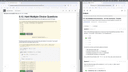
0Marauder Bot is an AI-powered Chrome extension designed to streamline solving technical questions on the web. It opens as a convenient side panel that automatically detects all open web pages, displaying each page’s title and URL, even if they are in separate Chrome windows. With Marauder Bot, users can select any open page, and with one click, analyze its technical questions. Whether the page contains multiple-choice or algorithmic problems, the extension will parse the content, identify relevant questions, and provide detailed analysis and solutions, powered by advanced AI models.
Frequently asked questions
GitHub Copilot is an AI-powered code autocompletion tool that generates code suggestions as you type. It can often autocomplete entire functions based on the initial input, significantly speeding up the coding process. Many developers find it indispensable for enhancing productivity and reducing the time spent on writing boilerplate code.
ChatGPT is a versatile AI tool that developers can use for coding assistance, brainstorming, and even generating recipes. It is known for its advanced conversational capabilities and is particularly useful for programming tasks. While it requires a subscription fee, many users find the investment worthwhile due to its effectiveness.
Vectorize.io is a tool designed to optimize unstructured data into vector search indexes, which are essential for retrieval-augmented generation. It helps developers efficiently structure their data, making it easier to implement vector search functionalities in their applications.
Rewritebar is an AI tool that enhances writing across any macOS application. It assists users in correcting grammar mistakes, changing writing styles, and translating text, making it a valuable resource for developers who need to communicate effectively in their documentation and code comments.
DevIntern streamlines the development process by transforming raw ideas into actionable tasks and pull requests. It automates the creation of well-defined tickets from vague descriptions and integrates with AI agents to implement code changes, significantly reducing the time spent on project management and code reviews.
Diffray utilizes a multi-agent architecture to provide specialized code reviews, focusing on various aspects such as security and performance. This approach results in fewer false positives and helps teams save time on pull request reviews, making it a more efficient tool for maintaining code quality.
SecVibe acts as an AI-powered security copilot that analyzes developer prompts and AI-generated code in real-time. It helps identify vulnerabilities and enforce secure coding practices during the development process, ensuring that security measures are integrated from the start rather than being an afterthought.
TypingMind is an advanced chat interface for interacting with various AI models. It supports custom API keys, allows the use of leading AI models, and includes features like text-to-speech capabilities. Its free tier makes it accessible for developers looking to enhance their AI interactions.
Act101 is designed for semantic code refactoring and supports a wide range of programming languages. It provides AI agents with the ability to perform structured code transformations while maintaining the integrity of the codebase. This tool is particularly useful for large-scale migrations and ensures that changes are safe and reversible.
Lisapet.ai is an AI product development platform that accelerates the prototyping and testing of AI features. It offers tools for prompt engineering, automated testing, and real-time analytics, enabling teams to develop and launch AI-powered features more efficiently while reducing manual testing efforts.