🔍Best Research Tools
This list includes various research tools designed to enhance the efficiency and effectiveness of academic and scientific inquiry. These tools provide functionalities that support data collection, analysis, collaboration, and project management, catering to the diverse needs of researchers across different fields.
- 0

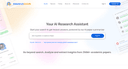
Stop drowning in browser tabs and research articles. ResearchCollab.ai is the ultimate research hub for content creators, students, and academics. It’s one place to manage all your documents, notes, and bookmarks. Upload your files and chat with them using over 50 AI models (like OpenAI and Claude). Get instant, cross-checked answers as one AI double-checks another. It's designed to speed up your research by 10x. Discover insights from over 250 million papers and spend less time sifting, more time creating.
- 0

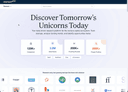
aVenture is a research tool for private companies and venture investing. Search 100,000+ startups and see their market, stage, fundraising, competitors, investors, news, and hiring. An AI analyst reads the latest coverage to summarize traction, highlight risks, and explain how new events may affect the company. What you can do: - Company research: discover competitors, nearby markets, and look-alikes to refine positioning or diligence a deal. - Investor mapping: see every company an investor has backed and filter by sector, stage, and geography to build a targeted outreach list. - News & signals tracking: follow companies, funds, or themes and get concise updates that surface material changes, not noise. - Workspace tools: save lists, annotate profiles, export data, and share research with a team. Who uses aVenture: Founders preparing fundraises, analysts running diligence or market maps, BD teams scouting partners/customers, and operators tracking their competitive landscape.
- 0

ManuSights is pre-submission quality control for the AI manuscript era. We help researchers catch citation, claim, and journal-fit risks before submission through live verification, diagnostic scoring, and manuscript-level review. Our goal is to make scientific publishing more trustworthy as AI accelerates manuscript production
- 0

Alma is an advanced AI platform designed around the concept of persistent memory, autonomous background agents, and unified creative tools. Unlike traditional AI assistants that forget previous conversations after each session, Alma is built to continuously remember user preferences, projects, communication styles, decisions, and ongoing work across every interaction. The platform positions itself as a long-term AI companion capable of evolving alongside the user, gradually building a deeper understanding of their goals, personality, workflows, and habits over time. By combining memory systems, research automation, creative studios, and productivity tools into one subscription, Alma aims to provide a more integrated and personalized AI experience. One of Alma’s core features is its persistent memory system. The platform automatically extracts useful information from conversations, such as personal preferences, writing styles, project details, recurring goals, and important decisions. These memories remain accessible across future chats, allowing the AI to maintain continuity and contextual understanding without forcing users to repeat the same information repeatedly. Users also remain in control of their stored memories, with options to review, edit, export, or delete saved data whenever needed. Alma describes this as a “complete memory system” that goes beyond simple vector storage by understanding personality traits, behavior patterns, communication preferences, and contextual relationships between topics. Another major feature of Alma is its system of autonomous background agents. Users can describe long-term goals or monitoring tasks in plain language, and Alma plans and executes them automatically over hours, days, or even weeks. Examples include competitor research, brand monitoring, scheduled reporting, trend analysis, or ongoing information gathering tasks. These agents operate independently in the background and periodically report findings back to the user. This functionality transforms Alma from a reactive chatbot into a more proactive digital assistant capable of managing long-term workflows and continuous research activities with minimal supervision. Alma also integrates multiple creative AI studios into a single workspace and pricing system. Users gain access to image generation, video creation, and music production tools under one shared monthly AI budget instead of paying for separate subscriptions across multiple platforms. The Image Studio supports advanced image models for generating, editing, upscaling, and refining visual content. The Video Studio includes support for cinematic AI video generation, storyboard planning, and avatar creation. Meanwhile, the Music Studio allows users to generate studio-style music tracks, focus loops, intros, and songs with optional vocals and lyrics. This unified creative environment is designed for creators, marketers, writers, designers, and content producers who need multimedia generation tools without managing multiple disconnected services. The platform also includes productivity and research-oriented capabilities aimed at writers, researchers, developers, and power users. Alma supports web search with AI-generated summaries, trend tracking, document generation, long-form writing assistance, grammar correction, translation, and export functionality for formats such as PDF, DOCX, XLSX, PPTX, HTML, Markdown, and JSON. Developers can access advanced integrations through APIs, bring-your-own-provider-key support, VS Code extensions, and MCP compatibility for connecting Alma with external development environments and AI-aware clients. These tools allow the platform to function not only as a conversational assistant but also as a workflow automation and knowledge management system. Another defining aspect of Alma is its emphasis on personalization and cognitive adaptation through what it calls the “Soul Engine v2.” This system allows the AI to develop a deeper understanding of user identity, worldview, communication style, reasoning preferences, and behavioral patterns. The goal is to create interactions that feel increasingly natural, context-aware, and tailored to individual users over time. Combined with automatic context assembly, Alma attempts to reduce the need for repetitive prompt engineering by dynamically selecting relevant memories and contextual information for each conversation. Overall, Alma presents itself as an all-in-one AI ecosystem that combines persistent memory, autonomous research agents, creative media generation, productivity tools, and personalized interaction systems into a unified platform. By focusing on long-term contextual understanding, automation, and integrated multimedia workflows, Alma aims to move beyond traditional chatbot experiences and become a continuously evolving AI workspace that adapts to the user’s personal and professional life.
- 0

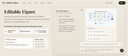
Editable Figure is an advanced AI tool specifically designed for researchers. It allows you to convert scientific figures generated by tools like Nano Banana, GPT Image 2, and others into fully editable vector formats. Unlike traditional vectorization tools or simple OCR, Editable Figure utilizes a sophisticated AI system that perfectly preserves the original structural information—such as text, frames, and arrows—ensuring they remain fully editable for further adjustments in software like PowerPoint, Adobe Illustrator, and Inkscape.
Frequently Asked Questions
One of the top research tools recommended by our users is ResearchCollab.ai. This platform serves as a comprehensive research hub, allowing content creators, students, and academics to manage their documents, notes, and bookmarks all in one place. With the ability to upload files and interact with them using over 50 AI models, ResearchCollab.ai enhances research efficiency by providing instant, cross-checked answers. It helps users discover insights from over 250 million papers, significantly speeding up the research process.
ResearchCollab.ai can dramatically improve your research process by consolidating all your research materials into a single platform. It allows you to manage documents, notes, and bookmarks efficiently, reducing the clutter of multiple browser tabs. The AI capabilities enable you to chat with your documents and receive instant answers, which can save you time and enhance your understanding of complex topics. This tool is designed to help you focus more on creating and less on searching.
ResearchCollab.ai stands out due to its unique combination of document management and AI interaction. Users can upload their research files and engage with them through various AI models, which provide cross-checked answers to queries. This feature not only enhances the accuracy of information but also allows researchers to gain insights from a vast database of over 250 million papers. The platform is designed to streamline the research process, making it faster and more efficient.