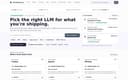
LLM Reference is a comprehensive AI model intelligence platform designed to help developers, startups, researchers, and businesses choose the best large language models for their specific use cases. The platform tracks the rapidly evolving AI ecosystem by monitoring models, providers, benchmarks, pricing changes, and performance updates across the entire generative AI market. Instead of manually comparing dozens of AI models and providers, users can use LLM Reference to quickly discover which models are best for coding, agents, writing, research, vision, long-context tasks, image generation, video generation, and much more.
The platform positions itself as a decision-making tool for teams building AI products. Because the AI landscape changes constantly with new models, benchmark updates, and price reductions appearing every week, LLM Reference focuses heavily on keeping information fresh and actionable. According to the platform, it currently tracks over 1,700 AI models, more than 130 providers, and hundreds of AI labs worldwide.
One of the most important features of LLM Reference is its model directory and comparison system. Users can search models by category, capability, or use case. Whether someone is looking for the best coding model, the cheapest frontier model, a model optimized for agents, or a long-context AI system, the platform organizes everything into structured leaderboards and curated recommendations.
The site includes specialized categories such as coding, RAG systems, autonomous agents, vision models, classification models, JSON and tool-use support, long-context processing, image generation, video generation, transcription, translation, and music generation. This makes the platform useful not only for developers building SaaS products, but also for creative professionals, research teams, and enterprise AI workflows.
LLM Reference also provides editorial “picks” and expert recommendations that simplify model selection. Instead of forcing users to analyze raw benchmarks manually, the platform highlights models considered best overall, cheapest, freshest, or strongest for specific audiences. For example, some models are recommended specifically for coding, while others are highlighted for research quality, writing style, agent reliability, or image generation capabilities.
Another major strength of the platform is benchmark tracking. LLM Reference continuously refreshes benchmark scores across major AI evaluation suites, allowing users to compare real-world model performance over time. Metrics from coding benchmarks, chatbot arenas, reasoning tests, and tool-use evaluations are consolidated into one place so teams can evaluate tradeoffs between quality, speed, and cost.
The platform heavily emphasizes pricing transparency as well. AI costs can vary dramatically depending on provider and usage scale, so LLM Reference tracks live pricing information including token costs, provider differences, and price cuts across the market. Users can compare which providers offer the lowest cost per million tokens while still maintaining competitive performance.
A particularly valuable section is the “Pulse” feature, which summarizes weekly changes across the AI industry. This includes newly released models, pricing updates, benchmark refreshes, and notable market shifts. Instead of monitoring dozens of AI company announcements manually, users can quickly understand what changed in the ecosystem during the week.
LLM Reference also supports provider comparisons and “most-asked comparisons” between major AI systems like GPT, Claude, Gemini, DeepSeek, and other frontier models. These side-by-side comparisons help developers determine which models best fit their workflow, budget, and technical requirements.
The platform appears especially useful for AI engineers, SaaS founders, AI agencies, growth teams, and technical decision-makers who need reliable information before integrating expensive AI infrastructure into products. Since AI capabilities and pricing evolve extremely fast, choosing the wrong model can lead to unnecessary costs, poor user experience, or technical limitations. LLM Reference aims to solve that problem by acting as a constantly updated intelligence hub for the AI model ecosystem.
Overall, LLM Reference is essentially a real-time research and comparison platform for the modern AI industry. By combining benchmark analysis, pricing intelligence, provider tracking, curated recommendations, and ecosystem monitoring into one interface, the platform helps users make faster and smarter decisions about which AI models to use for real-world applications.
0
Good to know
Frequently asked questions
One of the top AI pricing tools is LLM Reference. This platform serves as a comprehensive AI model intelligence hub, helping users choose the best large language models for various applications. It tracks over 1,700 AI models and provides insights on pricing, performance, and benchmarks, making it easier for businesses to optimize their pricing strategies. LLM Reference is particularly valuable for developers, researchers, and enterprises looking to make informed decisions about AI model integration.
LLM Reference assists businesses by providing a structured comparison of AI models based on their capabilities and pricing. It tracks live pricing information, allowing users to identify the most cost-effective options while maintaining competitive performance. The platform also features benchmark tracking, which helps users evaluate trade-offs between quality, speed, and cost, ensuring that businesses can make informed pricing decisions.
LLM Reference offers a model directory and comparison system that allows users to search for AI models by category, capability, or use case. It includes specialized categories for coding, vision models, and more, along with editorial picks and expert recommendations. Additionally, the platform provides side-by-side comparisons of major AI systems, helping users determine which models best fit their needs.
Pricing transparency is crucial in AI tools because costs can vary significantly based on the provider and usage scale. LLM Reference tracks live pricing information, including token costs and provider differences, enabling users to compare costs effectively. This transparency helps businesses avoid unnecessary expenses and select the most suitable AI models for their budget and requirements.
LLM Reference is particularly beneficial for AI engineers, SaaS founders, AI agencies, growth teams, and technical decision-makers. These users require reliable information to make informed choices about integrating AI models into their products, especially given the rapid evolution of AI capabilities and pricing in the market.