Home
Auto list · updated automatically

Best Self-Help Apps

4Items
0Contributors
0Votes
Sort by
  1. 1Renée Space

    I'm Grishma, co-founder of Renée Space. I'm building this from Toronto, and I'm honestly a bit nervous but really excited to share what we've created. This is my first time 🤞(btw, we'd love to have you in our community as we grow: https://www.instagram.com/reneespace.ai/) Why did we build this? I'll be real with you, this started from a deeply personal place. 4 years ago, I moved to Toronto as an immigrant. New city, new country, no friends, no support system. Just me in a tiny apartment, trying to figure everything out alone. The loneliness was suffocating. I was drowning in my own head, and there was no one to reach out to. No one who knew my story. No one who'd notice if I disappeared. Therapy would have been a great help but was expensive. I had mental breakdowns that brought me to the edge. There were moments I didn't think I'd make it through. Therapy would have been a great help but was expensive and would take lot of time & energy to fin the right one. When I desperately tried mental health apps, they made it worse. Every time I opened them, I was a stranger again. Re-explaining my situation, my background, why I was struggling, over and over. It wasn't support. It was exhausting. And then I realized, I wasn't alone in feeling this way. I started hearing the same thing from friends, from Gen Z and Millennials around me. We're living through a loneliness epidemic. 1.9 billion people worldwide are struggling with it. 79% of Gen Z, 71% of Millennials. So with Praharsh, I built Renée. An AI Friend who actually remembers your story, like a real friend would. The companion I wish I had during my darkest nights. The therapist I wish I had through my breakdowns What makes Renée different? 🧠 Persistent Memory - The thing nobody else is doing. This is her superpower. 🌼 Holistic Approach - She suggests ways you can be more holistic in your mental health journey. 🤍 Notifications - She reaches out when she senses you could use some help 💸 Forver Free - we know what's it feels like, so we made chat forver free

    0
  2. 2ClearMind AI

    ClearMind AI helps you identify distorted thinking, challenge irrational beliefs, and replace them with rational perspectives that lead to better decisions and better outcomes. Built around the powerful method of Rational Self-Analysis, ClearMind guides you through a structured process to examine the situations that trigger emotional reactions, uncover the thoughts driving those emotions, and reframe them with clear, objective reasoning. Instead of vague journaling or motivational advice, ClearMind uses proven psychological principles similar to those used in cognitive behavioral therapy to help you think more clearly and respond more effectively to life’s challenges. Over time, the system trains you to recognize irrational thinking patterns before they control your emotions or behavior. The result is greater clarity, emotional control, stronger relationships, and better decision making in everyday life.

    0
  3. 3Shadow OS

    Shadow OS is the first mobile app built entirely around decision-making. You type a question about something real you're dealing with and get one clear direction. Not five opinions. Not a pros-and-cons list. One answer you can act on. The framework draws on Carl Jung's concept of synchronicity, applied through 64 hexagrams — one of the oldest systems for understanding change and uncertainty. The app maps the specific situation you described and returns a direction, plus the psychological blind spot most likely to get in your way. It works across five life dimensions: Career, Love, Energy, Conflict, and Timing. Use it for major crossroads or daily decisions. Over time, it surfaces patterns in how you actually decide. Free on iOS and Android. One dimension is free forever. Premium unlocks all five, full reading history, and pattern analytics.

    0
  4. 4Neuralingual

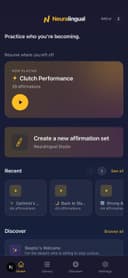
    Neuralingual is an AI-powered personal development platform designed to help users intentionally shape their mindset, habits, and self-perception through personalized spoken affirmations. Unlike traditional affirmation apps that rely on generic motivational phrases, Neuralingual focuses on creating deeply customized affirmation experiences based on each user’s goals, identity, emotional state, and desired personal transformation. The platform is built around a powerful core idea: the human mind is constantly absorbing messages from external sources such as social media, advertising, news platforms, entertainment, and online content. According to Neuralingual, these repeated inputs gradually influence beliefs, fears, behaviors, self-image, and expectations — often without conscious awareness. Instead of allowing outside systems to unconsciously shape identity, Neuralingual aims to give users control over the mental narratives they reinforce every day. The process begins by asking users to describe who they want to become. This can include goals related to confidence, productivity, creativity, fitness, emotional healing, discipline, success, relationships, spirituality, focus, or personal growth. The AI then generates affirmation scripts tailored specifically to the individual using principles inspired by psychology, neuroscience, identity-based behavior change, and performance coaching. One of the platform’s most distinctive features is its use of professional voice narration. Rather than simply displaying affirmations as text, Neuralingual transforms them into immersive spoken audio sessions. Users can choose from curated natural-sounding voices and listen to their personalized affirmations during activities such as morning routines, meditation, workouts, studying, walking, relaxation, or before sleep. The spoken format is designed to create a stronger emotional and psychological impact than reading alone. Neuralingual heavily emphasizes the concept of neuroplasticity — the brain’s ability to physically rewire itself through repetition and repeated thought patterns. The platform suggests that consistently listening to carefully structured affirmations can gradually reinforce new mental frameworks, helping users shift beliefs, emotional responses, and behavioral patterns over time. This approach is inspired in part by techniques used in elite athletic training, visualization practices, and mental conditioning. Another important aspect of the platform is its focus on believable affirmations. Neuralingual acknowledges that unrealistic or exaggerated affirmations can sometimes feel fake or emotionally disconnected. Instead of using generic “positive thinking” statements, the AI attempts to generate language that fits within the user’s “latitude of acceptance” — affirmations that feel emotionally realistic and psychologically acceptable, making them easier for the brain to internalize. The app also allows users to customize the tone and style of their sessions. Some users may prefer practical, grounded, and science-based affirmations, while others may lean toward spiritual, mystical, or deeply introspective approaches. Neuralingual adapts its output to fit different worldviews and emotional preferences, creating a more personal experience. The platform is currently available on iPhone through the App Store, with Android support planned for the future. Neuralingual uses a subscription-based model with a special founder’s pricing offer for early users. Subscribers receive monthly credits that can be used to generate affirmation sessions, access all available voices, and save unused credits over time. Built by Inner Stack Labs, Neuralingual positions itself as more than just an affirmation app. It presents itself as an AI-powered human development platform focused on intentional identity design, mental conditioning, and conscious self-programming. By combining artificial intelligence, voice technology, neuroscience concepts, and behavioral psychology, Neuralingual aims to help users actively shape the internal dialogue that influences their daily lives, decisions, and long-term personal growth.

    0
Good to know

Frequently asked questions