Best Health Tools
This list encompasses various health tools designed to assist individuals in managing their wellness and fitness goals. These tools provide valuable insights and calculations that can help users track their progress and make informed decisions about their health.
Frequently asked questions
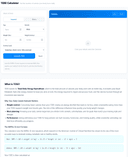
The TDEE Calculator is a user-friendly tool that estimates the total number of calories your body burns in a day, helping you understand your energy needs. By inputting personal details like age, gender, weight, height, and activity level, you receive a personalized estimate of your Total Daily Energy Expenditure (TDEE). This information is crucial for managing weight, as it helps you determine whether to consume fewer or more calories based on your fitness goals. Understanding your TDEE can also aid in meal planning by allowing you to distribute your calorie intake across macronutrients effectively.
Knowing your TDEE is essential for effective weight management because it indicates how many calories you need to maintain, lose, or gain weight. If you consume fewer calories than your TDEE, your body enters a calorie deficit, which can lead to fat loss over time. Conversely, consuming more calories than your TDEE creates a surplus that supports weight gain or muscle growth. By understanding your TDEE, you can set realistic dietary goals and adjust your calorie intake to achieve your desired body composition.
The TDEE Calculator uses the Mifflin–St Jeor equation to estimate your Basal Metabolic Rate (BMR), which reflects the energy your body requires at rest. This equation takes into account your weight, height, age, and gender to provide a reliable baseline of your energy expenditure. Once your BMR is calculated, it is multiplied by an activity factor that corresponds to your daily lifestyle, ranging from sedentary to highly active. This process results in an estimate of your Total Daily Energy Expenditure (TDEE).
While the TDEE Calculator provides a valuable estimate of your calorie needs, it is important to remember that it is not an exact number. Individual differences in metabolism, genetics, and daily habits can influence actual calorie requirements. Therefore, it is recommended to use the calculated TDEE as a starting point and monitor your progress over time. Adjust your calorie intake based on changes in body weight to better align with your health and fitness goals.
Once you know your TDEE, you can plan your meals by distributing your daily calorie target across macronutrients such as protein, carbohydrates, and fats. For instance, if your goal is to build muscle, you may prioritize higher protein intake, while someone focused on endurance activities might need more carbohydrates for sustained energy. By aligning your meal planning with your TDEE, you can maintain better control over your nutrition and support your training effectively.