This list encompasses various growth strategy tools designed to assist businesses in identifying and implementing effective strategies for expansion. These tools provide valuable insights and frameworks that help organizations analyze their market position and optimize their growth potential.
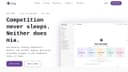
mia is an AI-powered market intelligence platform built to help growth-focused teams stay ahead in markets that never slow down. Positioned as a purpose-built alternative to generic conversational AI tools, mia continuously tracks competitors, customer signals, and market developments, transforming fragmented data into structured, actionable insights delivered directly to your dashboard, inbox, or Slack. Instead of reacting to change, teams using mia operate with always-on intelligence that keeps them proactive and strategically aligned.
Unlike general AI systems designed for broad tasks, mia is engineered specifically for competitor tracking, market research, and growth strategy. It combines automated monitoring with compliance-first data governance, aligning with GDPR, the EU AI Act, and ISO 27001 standards. This enterprise-grade foundation ensures that insights are not only powerful but also secure, transparent, and trustworthy—critical for modern organizations operating in regulated environments.
The platform stands out through its integrated intelligence modules, all unified within a single workflow. The Voice of Customer module aggregates sentiment and feedback from multiple sources, enabling teams to prioritize product roadmaps based on real user signals rather than assumptions. Product Match analyzes product–market fit through structured SWOT assessments and positioning gap analysis, helping businesses validate strategy with data. Competitor Watch automates competitor tracking with real-time alerts for launches, pricing changes, and strategic moves. Market Radar continuously scans trends, regulations, and emerging opportunities, surfacing insights before they become obvious to the wider market.
Getting started with mia is intentionally simple. Users input information about their business, competitors, and tracking goals. From there, the AI engine continuously scans and analyzes relevant signals, delivering structured reports and automated alerts within minutes. Reports can be generated with a single click and exported as PDF, Word documents, or slide decks—making it easy to share intelligence across teams and leadership.
mia emphasizes measurable business outcomes. It claims to accelerate insight discovery by up to 97%, replacing weeks of manual research with structured outputs delivered almost instantly. Teams report faster go-to-market cycles—between 30% and 50% improvements—along with tangible revenue growth and proven ROI. By removing the friction of manual data gathering and scattered analysis, mia enables organizations to focus on strategic execution rather than information hunting.
The platform is designed for companies at every stage of growth. Startups can validate markets and understand competitors without enterprise-level costs. SMEs gain advanced intelligence capabilities typically reserved for large corporations. Enterprises can unify intelligence across departments, products, and regions while maintaining compliance and governance standards.
Trusted by growth teams at global brands such as AWS, Bayer, Yaskawa, Signify, and Bosch, mia positions itself as the intelligence layer that transforms research from a periodic task into a continuous capability. Its core philosophy is simple: competition never sleeps, and neither should your market intelligence.
By turning weeks of manual market research into automated, ongoing insights, mia empowers organizations to move faster, make smarter decisions, and scale with confidence.
Analook is an advanced AI-powered competitive intelligence platform built for founders, startups, marketers, agencies, investors, and growth teams that want to understand exactly how competing companies attract customers, generate traffic, position their products, and scale their businesses. Instead of spending countless hours manually researching competitors across dozens of different websites and tools, Analook centralizes the entire process into a single report that can be generated in about 60 seconds simply by entering a company’s website URL.
Traditional competitor research often requires switching between SEO platforms, traffic analysis tools, social media channels, Product Hunt pages, GitHub repositories, pricing pages, review platforms, and web archives. Analook eliminates this fragmented workflow by automatically collecting and analyzing data from more than fifteen different sources simultaneously. The platform gathers information from traffic intelligence providers, SEO databases, Google Trends, social media platforms, Product Hunt, GitHub, the Wayback Machine, and other publicly available sources to create a comprehensive view of a company's online presence and growth strategy.
One of the platform’s most distinctive features is its AI-driven analysis engine. Rather than overwhelming users with spreadsheets and disconnected metrics, Analook interprets the data and provides an intelligent assessment of what is actually driving a competitor’s growth. The AI identifies key growth channels, highlights strategic advantages, evaluates marketing effectiveness, and explains why certain companies are outperforming others. This allows users to focus on decision-making rather than spending hours trying to understand raw analytics.
The platform provides a complete competitive intelligence report that covers multiple business dimensions. Users can examine traffic estimates, SEO performance, content strategies, social media engagement, community growth, Product Hunt performance, open-source activity, and overall market visibility. By bringing all of this information together, Analook helps users understand not only where competitors are today, but also how they got there and where future opportunities may exist.
A major component of Analook is its proprietary Strategy Radar system. This feature evaluates companies across various growth categories and presents the results in a visual format that makes strategic strengths and weaknesses easy to understand. Users can quickly identify whether a company excels in search engine optimization, content marketing, social media growth, community engagement, product-led growth, developer adoption, or brand awareness. This strategic overview helps businesses benchmark themselves against competitors and identify areas where improvements could generate the greatest impact.
For SEO professionals and content marketers, Analook provides valuable insights into competitor search strategies. Users can uncover keyword opportunities, analyze organic traffic patterns, study content performance, and identify topics that are driving visibility within a particular market. By understanding what competitors rank for and how they structure their content, businesses can develop more effective SEO campaigns and content marketing strategies.
The platform also helps startups and SaaS companies reverse-engineer successful growth models. Users can analyze how competitors acquire customers, what channels contribute most to growth, how they position their products, and which marketing initiatives appear to be producing results. This information can be especially useful for early-stage founders looking to validate business ideas, refine their positioning, or identify gaps in the market.
Another valuable capability is competitor comparison. Rather than analyzing a single company in isolation, Analook allows users to compare multiple businesses side by side. These comparisons reveal differences in traffic, audience reach, growth channels, pricing approaches, social influence, and overall market presence. This feature helps organizations understand where they stand relative to competitors and what strategic adjustments might be necessary to improve performance.
For growth-focused teams, Analook offers Growth Audits that provide a broader evaluation of a company’s online presence and market performance. These audits identify strengths, weaknesses, opportunities, and potential risks, making them useful for strategic planning, investor research, market analysis, and business development initiatives.
Developers and technical teams can integrate Analook directly into their existing workflows through a REST API and MCP server. This allows competitive intelligence reports to be generated programmatically and consumed by AI agents, internal dashboards, automation systems, and custom applications. Compatibility with platforms such as Claude Desktop, Cursor, and other AI-powered environments makes it possible to automate competitor monitoring and research tasks that would otherwise require substantial manual effort.
The platform is particularly valuable for SaaS founders, startup teams, product managers, growth marketers, agencies, consultants, venture capital firms, and business analysts who need fast, reliable, and actionable market intelligence. Instead of relying on assumptions or incomplete information, users gain access to a data-driven understanding of their competitive landscape.
Beyond the software itself, Analook publishes educational content focused on competitive intelligence, SEO analysis, startup growth, market research, and Product Hunt launch strategies. These resources help users learn best practices for competitor analysis and develop more effective growth strategies based on real-world examples and proven frameworks.
What makes Analook especially compelling is its emphasis on actionable insights rather than data collection alone. Many analytics tools provide metrics but leave users responsible for interpreting them. Analook takes a different approach by combining data aggregation, AI-powered analysis, strategic evaluation, and growth recommendations into a unified experience. This significantly reduces the time required to understand competitors and uncover growth opportunities.
Overall, Analook serves as a modern competitive intelligence solution that transforms a simple website URL into a comprehensive business analysis. By combining AI-generated insights, SEO intelligence, traffic analysis, social media monitoring, growth audits, strategic benchmarking, competitor comparisons, and developer-friendly integrations, the platform enables businesses to make smarter decisions, discover new opportunities, understand market leaders, and build more effective growth strategies based on real competitive data rather than guesswork.
0
Good to know
Frequently asked questions
One of the top growth strategy tools is mia, an AI-powered market intelligence platform designed to help growth-focused teams stay ahead in rapidly changing markets. Mia continuously tracks competitors, customer signals, and market developments, transforming fragmented data into actionable insights. It offers features like competitor tracking, market research, and growth strategy validation through structured SWOT assessments. Mia is particularly beneficial for organizations looking to enhance their market intelligence and accelerate their go-to-market cycles.
Mia assists businesses by providing always-on intelligence that keeps teams proactive and strategically aligned. It automates competitor tracking and market research, delivering structured reports and alerts that help organizations make informed decisions quickly. By replacing weeks of manual research with automated insights, mia enables faster go-to-market cycles and measurable business outcomes, making it a valuable tool for companies at every stage of growth.
Mia is designed for companies of all sizes, from startups to large enterprises. Startups can validate their markets and understand competitors without incurring high costs, while SMEs gain access to advanced intelligence capabilities typically reserved for larger corporations. Enterprises can unify intelligence across departments and maintain compliance with governance standards. Trusted by global brands like AWS and Bayer, mia is suitable for any organization looking to enhance its market intelligence.
Mia offers several key features, including the Voice of Customer module for aggregating sentiment and feedback, Product Match for analyzing product-market fit, Competitor Watch for real-time competitor tracking, and Market Radar for scanning trends and emerging opportunities. These integrated intelligence modules work together to provide comprehensive insights that help businesses validate their strategies and make data-driven decisions.
Mia is built with compliance-first data governance, aligning with GDPR, the EU AI Act, and ISO 27001 standards. This enterprise-grade foundation ensures that the insights provided are not only powerful but also secure, transparent, and trustworthy, which is critical for organizations operating in regulated environments.